Corrosion Under Insulation Prevention
The hidden enemy

Corrosion Under Insulation Prevention
Corrosion under insulation (CUI) is one of the most significant integrity threats on insulated industrial pipework and plant. It develops hidden — beneath insulation that looks intact — and is frequently not identified until it has caused significant wall loss or a leak. Fenix installs insulation systems specified to prevent CUI, and carries out insulation strip, inspection support, and re-insulation programmes on pipework and plant where CUI is a known or suspected risk.
CUI prevention starts at the insulation specification stage. The material selected, the thickness, the method of support, the sealing of joints and penetrations, and the design of the outer cladding system all affect how well the insulation excludes water and how quickly CUI develops if water does penetrate.
Fenix specifies insulation systems for CUI prevention in accordance with published industry guidance and BS EN ISO 12241. For carbon steel pipework in the high-risk CUI temperature window, we specify materials and methods appropriate to the service — avoiding materials that can wick and hold moisture, ensuring proper sealing of all cladding joints and penetrations, and specifying insulation supports that do not create water traps.
Where CUI is already a known risk — or where a client wants to strip and inspect existing insulation — Fenix carries out the strip work, exposes the pipework for inspection by the client’s inspection team or third-party NDT contractor, and re-insulates once the inspection is complete. We work efficiently around inspection programmes to minimise the time the pipework is exposed.
All CUI-related insulation work is documented with material specifications, installation records, and photographic evidence. Where the client’s integrity management system requires a specific record format, we provide documentation accordingly.
Why CUI Is a Significant Risk
CUI occurs when water penetrates the insulation system and contacts bare steel, causing accelerated external corrosion at the pipe or vessel wall. It is most active on carbon steel pipework operating in the temperature range of -4°C to 175°C — particularly on cyclic or intermittent services where condensation forms inside the insulation casing.
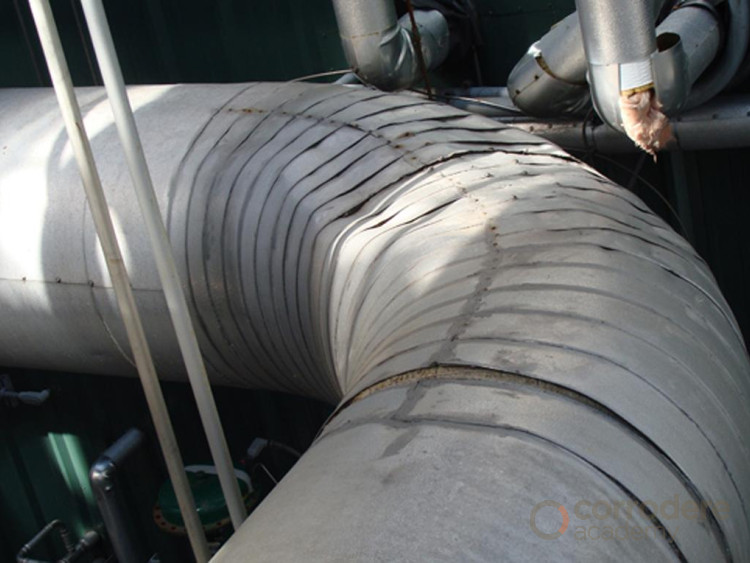
The failure mechanism is hidden by design. The outer cladding and insulation look intact. The corrosion is at the pipe wall, accumulating over months or years, until a leak, a planned inspection, or a system failure reveals it. At that point the scope and cost of remediation is typically far larger than a prevention programme would have been.
Effective CUI prevention requires the right insulation system, installed correctly, with a cladding system that excludes water ingress and is properly maintained. Fenix specifies and installs insulation systems in accordance with published CUI prevention guidance and ties all work back to the relevant BS standard.
What We Do
- CUI-resistant insulation system design and installation
- Insulation strip and re-insulation for CUI inspection access
- Condition survey of existing insulation for CUI indicators
- Weatherproof cladding systems to exclude water ingress
- High-temperature pipework CUI prevention specification
- Cyclic service pipework — specialist CUI prevention
FAQs
What is corrosion under insulation (CUI)?
CUI is external corrosion of pipework or equipment that occurs beneath the insulation, caused by water penetrating the insulation system and contacting bare or coated steel. It is most prevalent on carbon steel pipework operating in the -4°C to 175°C temperature range, particularly on cyclic or intermittent services, and in environments with high humidity or rainfall. CUI is difficult to detect by visual inspection and frequently goes unidentified until it causes a leak or is found during a planned inspection.
How does Fenix prevent CUI through insulation specification?
CUI prevention requires the right insulation system installed to the right standard. Fenix specifies materials appropriate to the service temperature and environment, avoiding materials that absorb and retain moisture. We ensure proper sealing of all cladding laps, joints, and penetrations, and specify insulation support methods that do not create water-holding pockets. All specification is tied back to BS EN ISO 12241 and published CUI prevention guidance.
Can Fenix strip existing insulation for CUI inspection?
Yes. Fenix carries out insulation strip work to expose pipework for CUI inspection — by the client’s inspection team or a third-party NDT contractor. We work efficiently to minimise the time the pipework is exposed and coordinate with inspection programmes to sequence the strip and re-insulation work around the inspection windows. Once inspection is complete, we re-insulate using a CUI-prevention specification.
What insulation materials are used for CUI prevention?
For pipework in the CUI risk temperature range, we specify cellular glass insulation (which is water-impermeable and vapour-tight) where CUI prevention is the primary requirement, or mineral wool with robust cladding and proper sealing where cellular glass is not practical. For cyclic or intermittent services where condensation risk is high, we specify insulation systems and cladding details appropriate to the cycling regime. Material selection is always documented and referenced to the relevant standard.
At what temperatures is CUI risk highest?
CUI is most active in the temperature range of -4°C to 175°C, with the highest corrosion rates typically in the 60°C to 120°C range — where the pipe temperature is sufficient to drive moisture cycling within the insulation but not high enough to dry it out in service. Cyclic services that regularly cross dew point are particularly vulnerable. Above approximately 175°C, the pipe temperature keeps the insulation dry, reducing but not eliminating CUI risk.
Gallery
The hidden enemy